Buying 1950s Baseball Cards: Topps, Bowman and the Condition Traps
The 1950s gave us some of the hobby's most iconic cards. Learn the Topps and Bowman era, common condition problems and how to avoid reprints and fakes.
By The Grail Hunt · July 26, 2026 · 6 min read
This guide contains eBay affiliate links. If you buy through them we may earn a commission, at no extra cost to you. Read our affiliate disclosure.
The 1950s are a golden decade for baseball cards. Two companies battled for collectors' pennies, the modern card design took shape, and the players on those cards — many of them Hall of Famers — are still household names. Buying cards from this era is deeply rewarding, but it requires a sharper eye than modern cards do, because condition problems, alterations and reprints are everywhere.
The Topps and Bowman era
Early in the decade, Bowman was the established name, and Topps entered the market in earnest with its landmark 1952 Topps set — large, colorful cards with player stats on the back that set the template for decades to come. The two companies competed fiercely until Topps acquired Bowman in 1956, leaving Topps as the dominant baseball card maker for many years.
A few things to know about the era:
- Card sizes changed from year to year and between brands, so a card that's the wrong size for its set is an immediate warning sign. Topps settled on the familiar 2-1/2" x 3-1/2" size in 1957.
- Many sets were released in series, and later "high-number" series were sometimes produced in smaller quantities, making them harder to find.
- Cards were sold in packs with gum, and many were handled, flipped, traded and stored in shoeboxes by kids.
Key cards and where the value is
The decade's most famous cards — the 1952 Topps Mickey Mantle and the 1951 Bowman rookies of Mantle and Willie Mays — sit at the very top of the market. Most collectors build around more attainable stars and rookies, including:
- 1954 Topps Hank Aaron #128, his rookie card.
- 1954 Topps Ernie Banks #94 and Al Kaline #201, both rookies.
- 1955 Topps Roberto Clemente #164 and Sandy Koufax #123, both rookies.
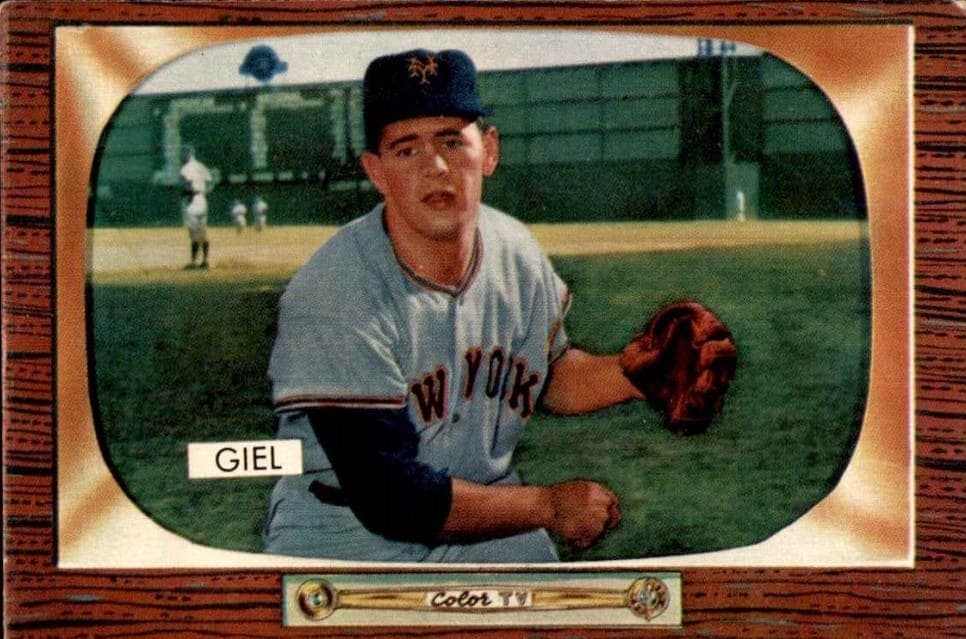
- 1955 Bowman, the set with the distinctive TV-set wood-grain frame design.
Value in this era is driven by the player, rookie status, condition and eye appeal. Commons from the same sets can be very affordable even in decent shape, which makes them a good way to learn the era before buying a star. For Hall of Famers, the market is deep enough that you can compare many sold copies, like the 1954 Topps Hank Aaron rookie featured in the price box above.
Condition issues to expect
Few 1950s cards survived in pristine condition. Look for these common problems:
- Centering. Cutting was imprecise, and off-center cards are the norm. Well-centered examples carry a premium.
- Corners. Soft or rounded corners are extremely common from handling and rubber bands.
- Wax and gum stains. Cards stored in packs picked up wax residue and gum stains, often on the back. These can affect grades significantly.
- Creases and wrinkles. Even light creases show up under raking light and lower grades considerably.
- Writing and marks. Kids often wrote on their cards, checked off checklists or added names.
- Print defects and toning. Print spots, color variation and yellowing stock are all part of the era.
A mid-grade card with strong eye appeal — good centering, bright color, no stains — often sells above a technically similar card that looks tired. Judge the whole card, not just the number.
Altered cards: trimming, recoloring and pressing
Because high-grade vintage cards are worth so much more, some cards are altered before they're sold or submitted:
- Trimming shaves a sliver off an edge to sharpen rough corners or edges. Measure suspicious cards and watch for edges that look too clean for a 70-year-old card.
- Recoloring fills in worn corners or border chips with ink or paint.
- Pressing and cleaning flatten wrinkles or remove surface dirt and wax.
Major graders typically refuse to give a number to cards they detect as altered. For a deeper look at the warning signs, see our guide to spotting trimmed, recolored and pressed cards.
Reprints and counterfeits
Popular 1950s cards have been reprinted and counterfeited for decades. Topps itself issued a reprint of the 1952 set in 1983, and many unofficial reproductions exist. Signs of a reprint or fake:
- Glossy or overly bright fronts, and card stock that looks too white or too thin.
- Wrong dimensions for the set.
- Blurry or pixelated printing, especially on text and fine lines, which suggests a scan of an original.
- Bright fluorescence under a blacklight. Many modern papers contain optical brighteners that glow under UV light, while vintage cardboard usually doesn't.
- Reprint markings on the back, which are sometimes scratched off or hidden.
Grail Hunt tip: For iconic 1950s cards — the stars and key rookies — buy graded. Authentication from a major grader is the single best protection against the reprints and counterfeits that flood this era.
Grading vintage cards
PSA, SGC and Beckett all grade vintage cards, and many vintage collectors are comfortable with any of the major graders. Keep in mind:
- Vintage cards in mid grades can still be very desirable. Don't expect high grades on 70-year-old cardboard.
- Some graders apply qualifiers for issues like off-centering or staining. A qualified grade usually sells for less than a straight grade.
- Cards can also be slabbed as "Authentic" without a numerical grade, confirming the card is real but noting it has been altered or is too damaged to grade.
Population reports matter even more for vintage. For many 1950s stars, PSA 8 and higher copies are scarce, which is why prices can climb steeply at the top of the scale. Our Graded Cards 101 guide explains how grade scales and population reports work.
Fake slabs exist for vintage cards too. Always look up the certification number, and compare any images on the grader's site with the card in the listing.
Buying safely online
- Request high-resolution scans of front and back, plus angled photos to reveal creases and surface issues.
- Ask whether the card has been cleaned, pressed or trimmed; honest sellers will tell you what they know.
- For graded cards, verify the certification number on the grader's website.
- Look at sold prices for the same card in the same grade.
- Buy from sellers with strong feedback for vintage sales, and use listings with buyer protection.
Good questions to ask a seller of a raw 1950s card:
- Where did the card come from, and how has it been stored?
- Can you photograph it next to a ruler, or another card from the same set?
- Are there any creases that only show when the card is tilted?
- Has it ever been submitted for grading?
A quick 1950s buying checklist
- Check the size against the set's correct dimensions.
- Look for wax, gum and writing on the back as well as the front.
- Tilt the card under light to find creases and surface wear.
- Be wary of edges that look too sharp for the card's age.
- Buy stars and key rookies graded, and confirm the cert number.
- Compare sold prices in the same grade from the same grader.
The bottom line
1950s baseball cards connect you to the hobby's roots, and their imperfections are part of their charm. Learn the era's quirks, expect condition issues, and let a reputable grader authenticate the big names. Do that, and you'll bring home genuine history instead of an expensive reprint.
The story behind it
More Sports Cards guides