Graded Cards 101: What a PSA 10 Really Means (and When It's Worth Paying For)
Grading can multiply a card's value — or add nothing. Here's how the 1–10 scale works and how to shop slabs smartly.
By The Grail Hunt · September 18, 2026 · 6 min read
This guide contains eBay affiliate links. If you buy through them we may earn a commission, at no extra cost to you. Read our affiliate disclosure.
Walk through any card listing today and you'll see the same thing: slabs. Graded cards sealed in hard plastic cases with a number on top. That number can be the difference between a $20 card and a $2,000 card. Here's what it actually means, how the major graders differ, and how to tell when a slab is worth the premium.
How the grading scale works
The major graders — PSA, BGS (Beckett), SGC and CGC — all score cards on a scale of 1 to 10. Four things drive the grade:
- Centering — how evenly the image sits inside the borders, front and back
- Corners — sharp and square, or soft and rounded
- Edges — clean, or chipped and whitened
- Surface — scratches, print lines, stains or dimples
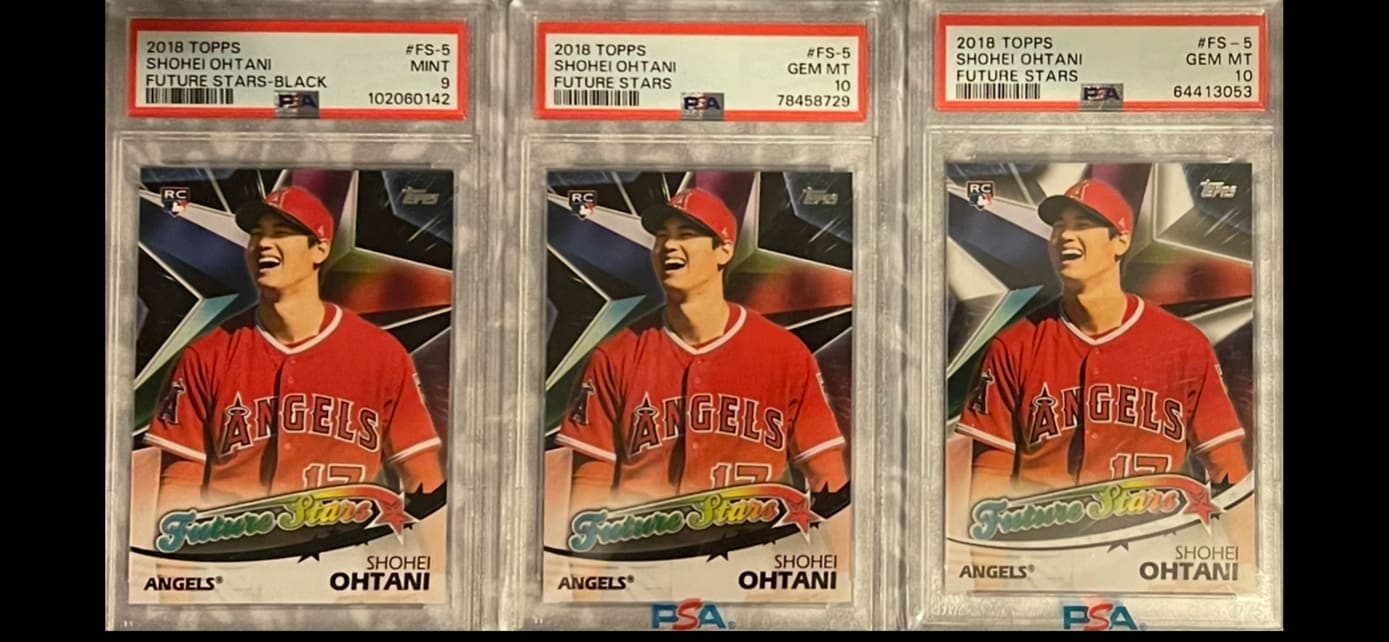
A PSA 10 Gem Mint is close to flawless under magnification. A PSA 9 Mint allows a minor flaw. The price gap between the two can be enormous for popular cards, because 10s are genuinely scarce.
Below that, PSA's scale runs 8 NM-MT, 7 NM, 6 EX-MT, 5 EX, 4 VG-EX, 3 VG, 2 Good and 1 Poor, with half-point grades in between for cards that sit at the top of their tier. For vintage cards, a 5 or 6 can be a very respectable copy. For modern cards pulled straight from a pack, anything below an 8 usually signals real damage.
How the big four graders differ
All four use a 1–10 scale, but the market treats them a little differently:
- PSA is the largest grader and typically commands the strongest resale prices, especially for vintage and high-end modern cards. Its labels show a single overall grade.
- BGS (Beckett) gives subgrades for centering, corners, edges and surface. A BGS 9.5 is its Gem Mint grade, while a Pristine 10 — and especially a Black Label with four perfect subgrades — is rare and can sell for a large premium.
- SGC is known for its black "tuxedo" label and has long been popular with vintage collectors.
- CGC, a big name in comics, has grown quickly in cards, particularly Pokémon and other trading card games.
The same numeric grade can sell for different amounts depending on the company. When you compare prices, compare like for like: a PSA 9 against PSA 9 sales, not against a BGS 9 or SGC 9.
What the grader looks for
Centering is measured as a ratio of border widths, like 60/40. PSA's published standard for a 10 calls for roughly 55/45 to 60/40 centering on the front, with more leeway on the back. A card that is visibly off-center is unlikely to get a 10, no matter how sharp the corners are.
Corners and edges are where handling shows first. Look for white "dings" on dark borders, fuzzy corner tips and rough cuts along the edges.
Surface problems are the hardest to see in photos: print lines, light scratches, indentations and factory roller marks. Tilt the card under a single light source and these often appear.
PSA can also add qualifiers such as OC (off-center) or ST (staining). A "PSA 8 OC" is graded on everything except centering and usually sells closer to a lower straight grade.
Population reports: the number behind the number
Every major grader publishes a population report showing how many copies of a card have received each grade. This is your best friend when judging price:
- A card with thousands of PSA 10s is unlikely to hold a big premium.
- A card with only a handful of 10s — especially a vintage one — can command many multiples of a 9.
The 1989 Upper Deck Ken Griffey Jr. rookie is a classic example. It was printed in huge numbers, so PSA has graded an enormous quantity of copies, including many 10s. Even so, the jump from a 9 to a 10 is roughly tenfold, because collectors pay heavily for the top grade. Browsing PSA 9 Griffey rookies is a good way to see how small the visible difference can be.
Remember that population reports count grading events, not unique cards. Some copies are cracked out and resubmitted in hopes of a higher grade, which can inflate the counts over time.
Grail Hunt tip: Before bidding on a high-grade slab, look up its population. If the "rare" 10 has a pop of 20,000, the seller's premium probably isn't justified.
Is raw or graded the better buy?
Buy graded when the card is expensive, frequently counterfeited, or when condition makes a big price difference. The slab gives you authentication and an agreed-upon condition.
Buy raw when you're collecting for the love of it, the card is inexpensive, or you're confident in judging condition yourself. Raw cards are cheaper, and some collectors hunt for raw cards they believe will grade well.
If you plan to submit a raw card yourself, be realistic. Grading costs money and takes time, and most modern cards do not come back as 10s. Grading usually only makes financial sense when the value gap between grades is bigger than the cost of grading.
Spotting fake slabs and altered cards
As slabs became more valuable, counterfeiters followed. Common problems include:
- Fake slabs. Counterfeit cases with copied labels, sometimes holding a reprint. Check the label font, the hologram and the overall fit against a known genuine slab.
- Swapped cards. A real slab that has been opened and resealed with a lower-quality card inside. The cert number checks out, but the card doesn't match the grader's images.
- Trimmed or recolored cards. Raw cards that have been cut to sharpen edges, or touched up to hide wear, before submission. Graders catch many of these, but not every one. Our guide to trimmed, recolored and pressed cards covers the warning signs in detail.
- Reprints in "Authentic" slabs. A slab marked Authentic or Altered has no numeric grade. That isn't automatically bad, but it's not the same as a graded card and should be priced accordingly.
Protect yourself when buying slabs online
- Verify the cert number. Every slab has a certification number you can check on the grader's website. Make sure the card, year and grade match the listing — and if the grader shows scan images, compare them to the seller's photos.
- Inspect the case. Cracked, cloudy or oddly thick cases can indicate tampering.
- Ask for real photos. Request clear front and back shots of the actual slab, not stock images, plus an angled shot to show the surface.
- Use buyer protections. eBay offers an Authenticity Guarantee on many trading cards above a certain price — check the listing for the badge.
Questions worth asking a seller:
- Has the card ever been cracked out or regraded?
- Are these photos of the exact slab I will receive?
- Are there any chips, scratches or cracks in the case?
Check prices the right way
Asking prices tell you what a seller hopes to get. Sold prices tell you what the market actually pays. Filter eBay to completed and sold listings, match the exact card, grader and grade, and look at several recent sales rather than one outlier. Our sold-listings price check guide walks through the process step by step.
A quick slab-buying checklist
- Confirm the set, year, card number and any parallel in the listing title and on the label.
- Look up the cert number and compare the grader's images.
- Check the population report for that grade and the one above it.
- Compare at least three recent sold prices for the same grader and grade.
- Inspect photos of the case for cracks, tampering or label issues.
- Buy from sellers with strong feedback and use listings with buyer protection.
The bottom line
A grade is a shortcut to trust and condition, not a guarantee of value. Combine the grade with the population report and recent sold prices, and you'll know whether that slab is a grail — or just an expensive piece of plastic.
The story behind it

More Sports Cards guides