Buffalo Nickel Key Dates, Varieties and the Fakes That Follow Them
From the 1913 Type 1 and Type 2 to the famous 1937-D three-legged, here's how to hunt Buffalo nickel keys without falling for acid-restored dates or altered coins.
By The Grail Hunt · August 9, 2026 · 6 min read
This guide contains eBay affiliate links. If you buy through them we may earn a commission, at no extra cost to you. Read our affiliate disclosure.
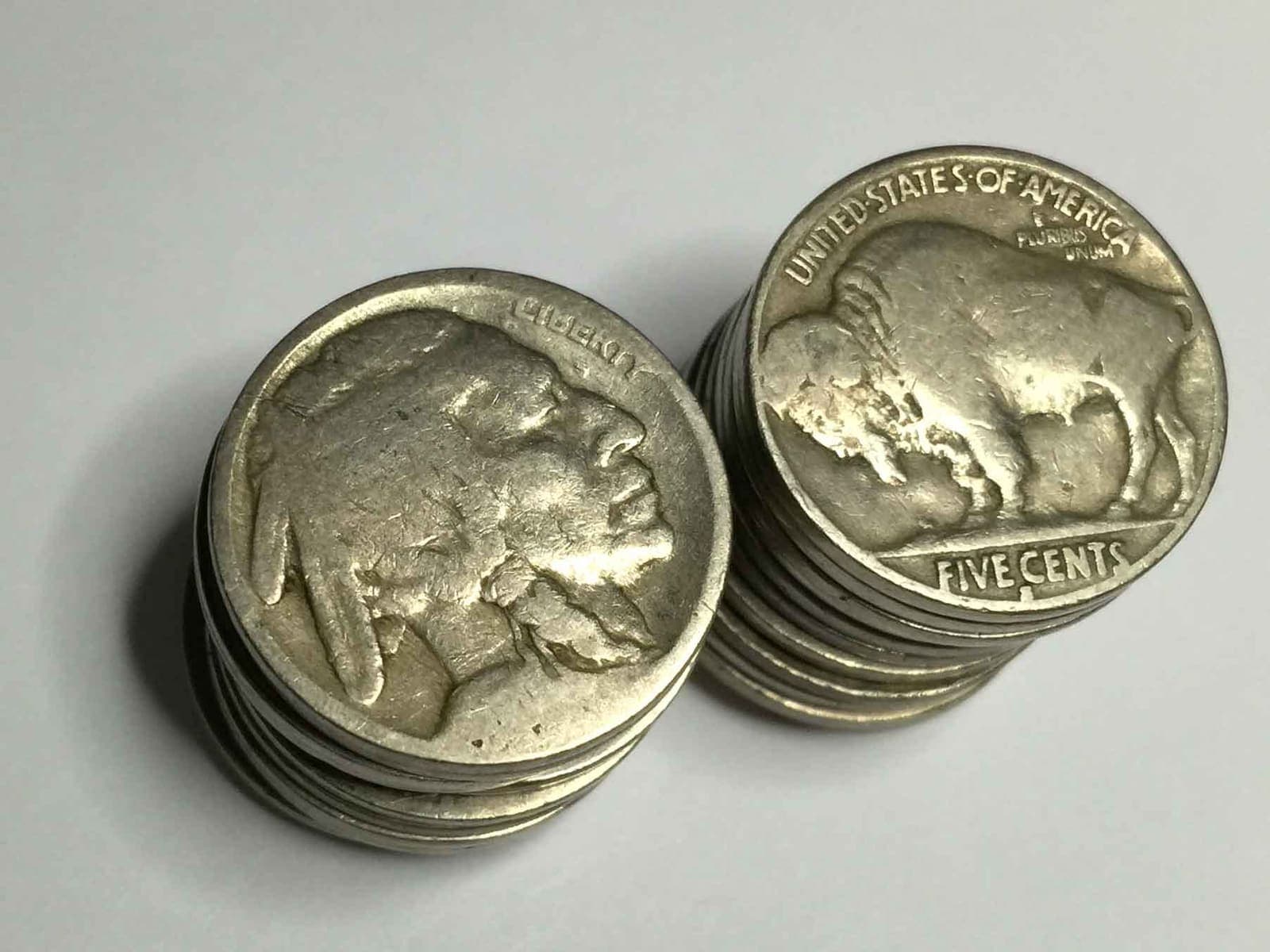
The Buffalo nickel — officially the Indian Head nickel — was struck from 1913 to 1938 and is one of the most loved designs in American coinage. James Earle Fraser's rugged Native American portrait and bison look fantastic, but the design had a weakness: its high points, including the date, wore away fast. That single flaw shapes almost everything about collecting the series today, from what counts as a key date to how the fakes are made.
1. Know the two 1913 types
The first year of issue came in two versions, and you should be able to tell them apart at a glance:
- Type 1 — The bison stands on a raised mound, and the words FIVE CENTS sit on that mound where they wore off quickly.
- Type 2 — The Mint cut the mound down to a flat line and recessed FIVE CENTS beneath it to protect the denomination.
Both types were struck at Philadelphia, Denver and San Francisco in 1913. The 1913-S Type 2 is the scarcest of the six and one of the series' true keys. The mint mark, when present, sits on the reverse below FIVE CENTS.
2. The keys and varieties collectors chase
Beyond 1913, a handful of coins drive the market:
- 1937-D "three-legged" — Over-polishing of a reverse die removed most of the bison's front leg. It's the most famous Buffalo variety of all.
- 1918/7-D overdate — A 7 from the previous year's die shows beneath the 8. Rare and heavily faked.
- 1916 doubled die obverse — Strong doubling on the date. A major rarity.
- Branch-mint dates of the 1920s — Several Denver and San Francisco issues, such as the 1921-S, 1924-S and 1926-S, are scarce, and much harder still with a full, sharp strike.
Many branch-mint coins of this era were weakly struck, so a sharp, high-grade example is far more desirable than a typical one.
3. What drives value
Four things decide what a Buffalo nickel is worth:
- Date and mint mark. The keys above carry the big premiums. Most Philadelphia dates from the 1920s and 1930s are common in circulated grades.
- A full, readable date. Because the date wore away so easily, a clear date is the first thing buyers look for. Partial-date and no-date coins sell for little more than their metal and novelty value, even if the rest of the coin looks decent.
- Grade. Circulated values rise steadily with detail, and Mint State examples of the better dates can be worth many times a Very Fine coin.
- Strike and eye appeal. Two coins with the same grade can sell far apart if one has a sharp horn, crisp hair braid and attractive, original color.
If you're new to grade labels like G-4, VF-20 and MS-63, our guide to the Sheldon scale explains how the numbers work.
4. Watch for acid-restored dates
Because the date sits on the Indian's shoulder, millions of Buffalos wore down to "no date" coins. Hobby products were once sold that use acid to etch the metal and make a ghost of the date reappear. These acid-treated coins are easy to spot once you know the look:
- A dull, frosty or etched patch around the date that doesn't match the rest of the coin
- A date that's readable while the surrounding details are completely worn
- Discoloration or a "stained" area on the shoulder
An acid-restored coin is considered damaged and sells at a heavy discount, so never pay key-date money for one. And don't try restoring a date yourself: it permanently damages the coin.
Grail Hunt tip: Ask sellers for a close, angled photo of the date area under a single light source. Acid etching shows up as a matte, pitted texture that ordinary wear never produces.
5. Spot altered mint marks and tooled legs
The two biggest money-makers for fakers are the 1937-D three-legged and the S-mint keys.
- Tooled three-leggers. Someone scrapes the front leg off an ordinary 1937-D. Look for a scraped or disturbed field where the leg should be. Genuine coins show a characteristic line of raised die-polish marks running down from the bison's belly, plus other known die markers — compare against certified examples.
- Added or altered mint marks. A common Philadelphia coin gets an S or D glued on, or a D gets tooled into an S. Check for seams, an odd angle, mismatched color or a letter shape that doesn't match genuine references.
- Altered dates. Digits can be re-engraved, especially on overdates. Compare every digit against photos of certified coins.
Two more traps are worth knowing:
- The 1936-D "3½ legs." A different, much less valuable variety where part of the front leg is missing. It's sometimes sold to buyers who think they're getting a 1937-D. Check the date before you get excited about the leg.
- Sliders. Lightly worn three-leggers and branch-mint keys are often offered as "uncirculated". Look for flat, discolored high points on the Indian's cheek and the bison's hip and shoulder.
6. Cleaned and damaged coins
Buffalo nickels are made of 75% copper and 25% nickel, and original surfaces tend to tone to soft gray, tan or gold. Be cautious of:
- Bright, shiny circulated coins — A worn coin shouldn't look freshly minted. That usually means cleaning or polishing.
- Hairlines — Fine parallel scratches in the fields from wiping or brushing.
- Whizzing — A wire-brushed surface that fakes luster but looks grainy under magnification.
- Corrosion and dark spots — Common on coins stored in damp conditions.
These coins come back from grading services with a "Details" grade and sell at a discount. Our guide on how to tell if a coin has been cleaned covers the warning signs.
7. Grading and buying safely online
Buffalo nickels are graded on the standard 1–70 scale, but collectors pay close attention to the horn on the bison and the strike on the hair braid. A full horn is a big plus on any date. Keep these rules in mind when buying:
- Request sharp photos of both sides, plus the date and mint mark close up
- Ask whether the coin has been cleaned, dipped or treated — and get the answer in writing
- For any key date or major variety, buy it certified by PCGS or NGC and verify the certification number on the grader's website
- Use a marketplace with buyer protection, and pay through its own checkout
Questions to ask a seller
- Can you send a close-up of the date and the mint mark under a single light?
- Has the date been restored, or the coin cleaned, dipped or treated?
- For a three-legger: can you show the area under the belly and where the front leg would be?
- Is the coin returnable if it doesn't grade or is called not genuine?
Red flags in listings
- Key dates or major varieties priced well below recent sold prices
- "Three-legged" listings with no clear photo of the date
- Raw coins described as "uncirculated" with blurry or angled-away photos
- A sharp, readable date on an otherwise heavily worn coin
- Holders from little-known grading companies, or cert numbers that don't verify
Quick buyer's checklist
- Date fully readable, with no etched or stained patch around it
- Mint mark in the right place, cleanly raised, correct style
- Wear consistent across the whole coin
- Original, natural-looking color with no hairlines
- Three-leggers checked for the genuine die markers
- Certified and cert-verified for keys and major varieties
- Buyer protection and a clear return policy
The bottom line
Buffalo nickels reward patience. Learn the 1913 types, memorize the handful of keys, and train your eye to catch acid-treated dates, tooled legs and added mint marks. Buy the big coins slabbed from sellers with a strong track record, and you'll enjoy one of the most beautiful series America ever struck.
More US Coins guides