Stories · Culture · Vintage Jewelry
Black Jet and Braided Hair: The Story of Victorian Mourning Jewelry
When Prince Albert died, Queen Victoria wore black for nearly forty years and a nation followed her into jet, hairwork and jewelry made to keep the dead close.
By The Grail Hunt · August 16, 2026 · 6 min read
On December 14, 1861, Prince Albert, the husband of Queen Victoria, died at Windsor Castle. He was forty-two. The queen was devastated, and her grief did not follow the usual course. She withdrew from much of public life for years, kept many of his rooms as they had been, and wore black mourning dress for the rest of her life, which lasted almost four more decades, until her death in 1901. Her long mourning shaped the look of an era. In Britain and far beyond it, grief acquired a wardrobe, and that wardrobe came with jewelry.
An old habit made fashionable
Jewelry for remembering the dead was not a Victorian invention. For centuries, Europeans had worn memento mori pieces, from the Latin phrase meaning "remember that you must die." Rings and pendants from the sixteenth and seventeenth centuries carried skulls, skeletons, coffins and hourglasses, reminders of mortality meant as much for the wearer's soul as for the memory of anyone in particular.
By the eighteenth century the emphasis had shifted from death in general to the dead person in particular. Mourning rings were commonly given out at funerals, and people sometimes left money in their wills to pay for them, so that friends and relatives would wear a ring bearing the name and dates of the deceased. Georgian mourning jewelry often featured delicate painted scenes of weeping willows, urns and grieving figures, sometimes worked with the hair of the person being remembered.
What changed in the Victorian era was scale. Mourning became an elaborate social code, with expectations about what should be worn, and for how long, depending on one's relationship to the dead. Full or deep mourning demanded dull black fabrics and very restrained ornament, and later stages allowed a gradual return to color and decoration. A widow's mourning was expected to last the longest. The queen's example reinforced these customs, and a growing middle class, with more money to spend and more interest in propriety, adopted them widely.
The jet of Whitby
The jewel most closely associated with Victorian mourning is jet, and the most prized jet came from the coast around Whitby in Yorkshire. Jet is not a stone in the usual sense. It is a form of fossilized wood, formed from ancient trees buried and compressed over many millions of years. It is light, warm to the touch, and can be carved in fine detail and polished to a deep, glossy black.
Whitby had a jet industry before Albert's death, and jet was shown at the Great Exhibition in London in 1851. But the fashion for mourning jewelry in the 1860s and 1870s turned it into a boom. Workshops in the town multiplied, and by some accounts the trade came to employ well over a thousand people at its height. Carvers produced brooches, lockets, bracelets, beads and cameos, many with naturalistic motifs such as flowers, leaves and clasped hands, alongside simpler faceted pieces for those in deepest mourning.
A seaside town in Yorkshire became the center of a national industry because a queen's grief turned a black fossil into the most fashionable material in Britain.
Imitation blacks
Demand for black jewelry was greater than genuine Whitby jet could supply, and it was more than many buyers could afford. Cheaper alternatives filled the gap. The best known is the material sold as "French jet," which is not jet at all but black glass. It could be molded and faceted to catch the light, and it was heavier, colder and more brittle than real jet.
Vulcanite, a hardened rubber made possible by the vulcanization process patented by Charles Goodyear in the 1840s, was another popular substitute. It could be molded into detailed shapes that imitated carved jet at a fraction of the effort. Over time, vulcanite often fades from black toward a brownish or olive tone, especially when exposed to light, and this change is one of the ways collectors recognize it today. Other black materials, including bog oak from Ireland and gutta-percha, a natural latex, were also used for mourning pieces.
Hair, the most personal material
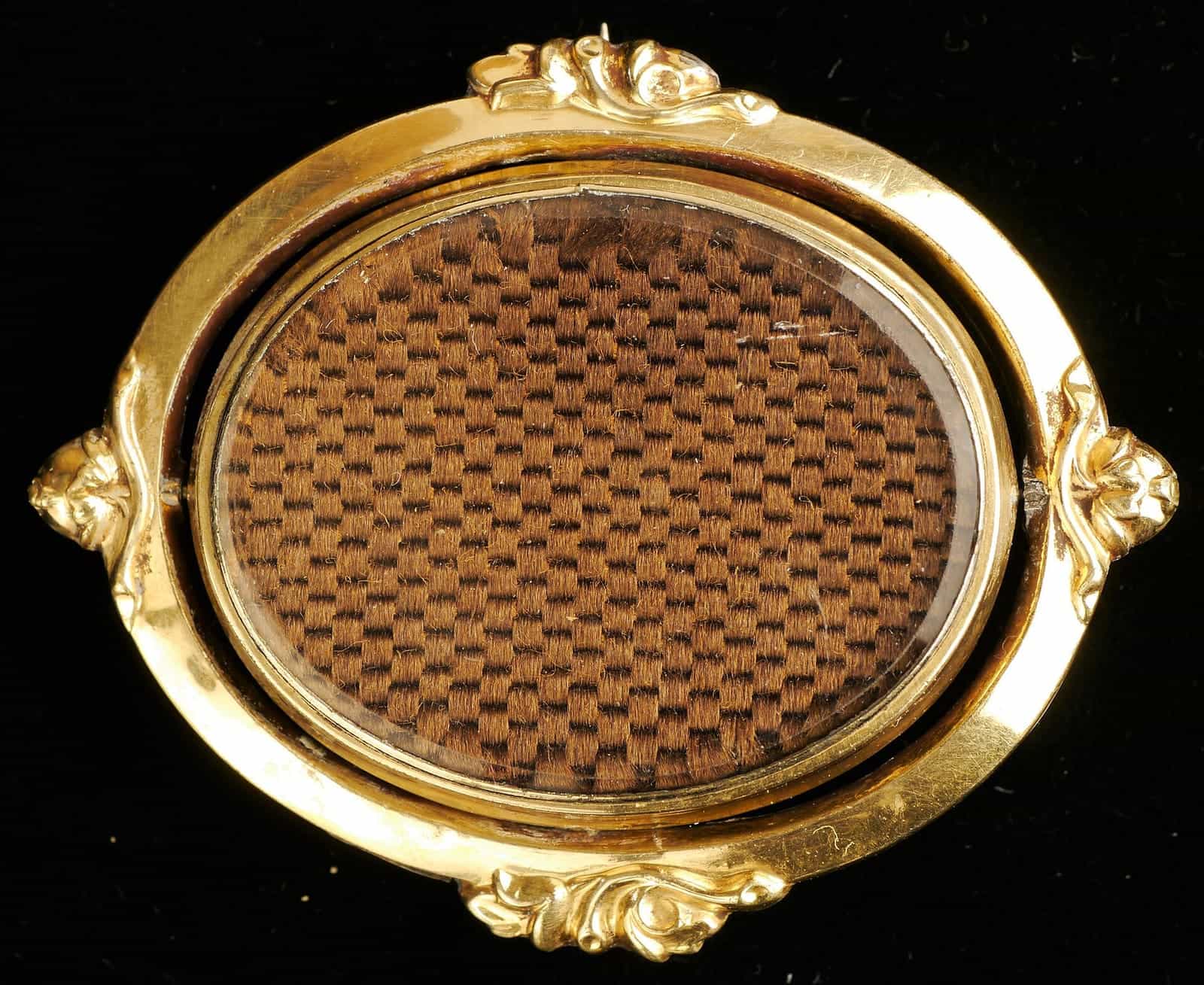
If jet was the public face of mourning, hair was its most intimate element. Victorian mourning jewelry frequently incorporated the hair of the deceased, either as a lock placed behind glass in a brooch, locket or ring, or woven and braided into the jewelry itself. Skilled hairworkers produced chains, bracelets, watch fobs and earrings made entirely from intricately plaited hair, and women's magazines and manuals of the period taught readers how to do the work at home.
Hair lasts, and that was part of its meaning. It could be kept long after everything else about a person had gone. There were also worries at the time about whether commercial hairworkers always used the hair they had been given, rather than substituting hair from another source, and this is one reason some families preferred to do the work themselves. How often substitution actually happened is impossible to know.
Not all hairwork jewelry was about death. Hair was also exchanged as a token of love and friendship, and many pieces commemorate the living. Without an inscription or a clear mourning motif, it can be difficult to tell which is which.
The fashion fades
By the later decades of the nineteenth century, the strict customs of mourning were loosening, and fashions in jewelry were changing. The Whitby jet trade declined as demand fell and cheaper substitutes spread. The enormous scale of loss in the First World War transformed mourning practices again, and elaborate Victorian-style mourning dress largely faded from everyday life in the decades that followed.
What it means for collectors
Victorian mourning jewelry survives in considerable quantity, because so much of it was made and because families kept it for sentimental reasons long after the fashion had passed. For collectors, the first challenge is usually identifying the material.
Genuine jet is noticeably light and feels warm in the hand compared with glass. French jet, being glass, is heavier and colder, and a close look at edges and facets can show the sharpness or chipping typical of glass. Vulcanite is also light, but it often shows signs of molding rather than carving, and its tendency to fade to brown is a strong clue. Some collectors use streak tests on unglazed porcelain, or note the faint smell of sulfur that vulcanite can give off when rubbed, but any test that scratches, heats or damages a piece should be avoided on something old and irreplaceable. When in doubt, an experienced dealer or appraiser is the safer route.
Inscriptions, engraved names and dates, and the style of a clasp or setting can all help date a piece and tell its story. Hairwork should be examined carefully for damage, since fine braids can break or unravel.
Care is mostly a matter of gentleness. Jet can crack or chip if dropped and should not be exposed to heat or harsh cleaning. Vulcanite should be kept out of strong light. Hair should be kept dry and handled as little as possible, and glazed compartments are best left sealed. Treated with that care, these pieces carry something that very little jewelry does: a direct, physical link to a particular person, and to the long Victorian effort to keep the dead close.
More stories