Signed Vintage Costume Jewelry: Reading Marks and Spotting Fakes
Trifari, Eisenberg, Haskell and more — how maker's marks changed over time, how to judge rhinestones, and how to catch replaced stones and fake signatures.
By The Grail Hunt · July 5, 2026 · 3 min read
This guide contains eBay affiliate links. If you buy through them we may earn a commission, at no extra cost to you. Read our affiliate disclosure.
Vintage costume jewelry was never meant to be precious — yet the best signed pieces are now some of the most collected jewelry around. A name on the back can make a brooch far more desirable than an unsigned twin, which is exactly why marks deserve a careful look. Here's how to buy signed pieces with confidence.
Know the names
Many companies made fine costume jewelry during the 20th century. Some of the names collectors look for include:
- Trifari — known for elegant designs and high-quality plating and stones
- Eisenberg — prized for bold, sparkling rhinestone pieces
- Miriam Haskell — famous for intricate beadwork and faux pearls
- Coro and Corocraft — a huge producer with a wide range of quality
- Weiss, Schiaparelli, Monet, Napier and Sarah Coventry — each with its own look and following
Learning a maker's typical style is as important as reading the mark. A signature on a piece that looks nothing like the maker's work should make you pause.
How marks changed over time
Maker's marks weren't static, and those changes can help date a piece:
- Many makers used several different signatures over the decades — different fonts, logos or name forms.
- Patent numbers and "Pat. Pend." marks appear on some pieces from the earlier decades.
- The copyright symbol (©) alongside a maker's name generally appears on American costume jewelry from the mid-1950s onward, so a © mark on a supposedly 1930s piece is a mismatch.
- During the World War II era, metal restrictions led some makers to use sterling silver for costume pieces, which are now collected in their own right.
- Some makers, like Miriam Haskell for much of its early history, often didn't sign their work at all.
Reference books and collector forums document which marks each maker used and when.
Check the rhinestones
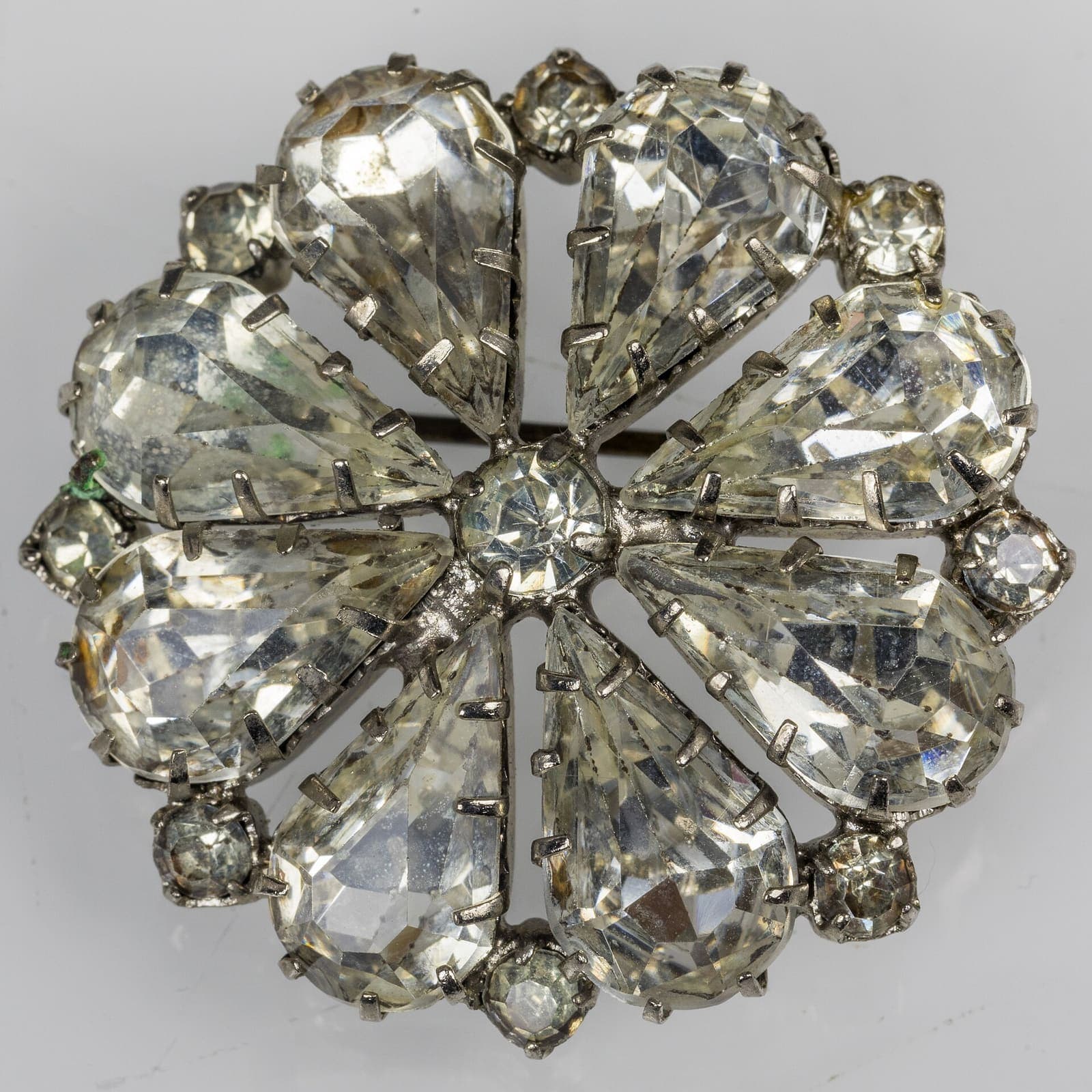
Rhinestone condition makes a big difference to value. Look for:
- Dead stones — rhinestones whose foil backing has deteriorated, often from moisture, leaving them dull, cloudy or dark
- Chips and scratches on the stone surfaces
- Missing stones, which break the sparkle and are sometimes replaced
Ask for photos in natural light, both straight on and at an angle. Dead stones often look fine in flash photos but dull in daylight.
Spot replaced stones
Replacement stones are common and not always disclosed. Signs include:
- A stone that's slightly different in color, size or cut from its neighbors
- Excess glue around a setting
- A stone that sits higher or lower than the others
- Bent or reworked prongs
A few well-matched replacements may be acceptable on a common piece, but they should lower the price.
Watch for fake signatures
As signed pieces became collectible, fake signatures followed. Reproductions bearing famous names are widespread. Warning signs:
- A mushy, shallow or uneven mark, especially on a cast piece where the signature should be crisp
- A signature plaque that looks glued on rather than original to the piece
- Lightweight metal, poor plating or crudely set stones
- A design that doesn't match anything in the maker's known catalog
- Multiple identical "vintage" pieces from the same seller
Compare the mark to verified examples from the same era, and be especially careful with the most copied names.
Grail Hunt tip: Ask for a sharp close-up of the signature and the back of the piece. The back — plating wear, construction, clasp and pin style — often tells you more about age and authenticity than the front.
Buy safely online
Choose sellers who describe condition honestly, including stone problems and plating wear. Ask about any repairs. Request photos in natural light and at multiple angles. Pay through the platform so you're covered by its buyer protection, and check the return policy before you buy.
The bottom line
Learn the makers, learn how their marks evolved, and judge the stones as carefully as the signature. A crisp, period-correct mark on a well-made piece with bright, original stones is what signed costume jewelry collecting is all about.
The story behind it
More Vintage Jewelry guides