Real vs. Fake Pearls: How to Tell Natural, Cultured and Imitation
The tooth test, luster, drill holes, knotting and clasps all offer clues. Here's how to tell real pearls from imitations, and when to call in a gemologist.
By The Grail Hunt · July 3, 2026 · 3 min read
This guide contains eBay affiliate links. If you buy through them we may earn a commission, at no extra cost to you. Read our affiliate disclosure.
A strand of pearls looks simple, but there's a world of difference between a natural pearl, a cultured pearl and a well-made imitation. Vintage listings often blur those lines — sometimes innocently, sometimes not. Here's how to sort them out.
Natural, cultured and imitation
Start with the three main categories:
- Natural pearls form inside a mollusk without human help. They're rare, especially in matched strands, and older natural pearls are highly prized.
- Cultured pearls are grown in mollusks after people introduce a nucleus or piece of tissue. They're real pearls with real nacre. Common types include akoya, freshwater, South Sea and Tahitian.
- Imitation pearls are made of glass, plastic or shell, coated to look like pearls. Some are high quality; many are simple costume beads.
Most real pearls on the market today are cultured. Telling natural from cultured requires laboratory testing, but telling real from imitation is often something you can start on yourself.
The tooth test
The classic check: gently rub a pearl against the edge of your front teeth. Real pearls, natural or cultured, usually feel slightly gritty or sandy because of their layered nacre. Most imitations feel smooth or glassy.
Keep in mind:
- Be gentle, and clean the pearls first.
- Some high-quality imitations are designed to fool this test.
- The test can't tell you whether a pearl is natural or cultured.
Rubbing two pearls together gently can give a similar gritty feel.
Luster and surface
Luster — the way light reflects from and within a pearl — is one of its most important qualities. Real pearls tend to show deep, sharp reflections and subtle color overtones. Imitations often look flat, chalky or uniformly glossy.
Look at the surface, too. Real pearls usually show small irregularities: tiny bumps, spots or variations in shape. A strand where every bead is perfectly round and identical may be an imitation.
Drill holes tell tales
Examine the drill holes under magnification if you can, or ask the seller for close-up photos. With imitations, the coating often chips, peels or wears away around the hole, revealing glass or plastic underneath. On real pearls, you may see the boundary between the nacre and the nucleus, and the edges are usually crisp rather than flaking.
Also check for wear on the surface where pearls rub together; worn coatings on imitations can expose a different material.
Knotting and clasps
How a strand is strung offers useful context:
- Fine strands are usually knotted between each pearl, so pearls don't rub or scatter if the string breaks.
- Look for dirty, stretched or frayed string, which means the strand needs restringing — a normal maintenance cost to factor in.
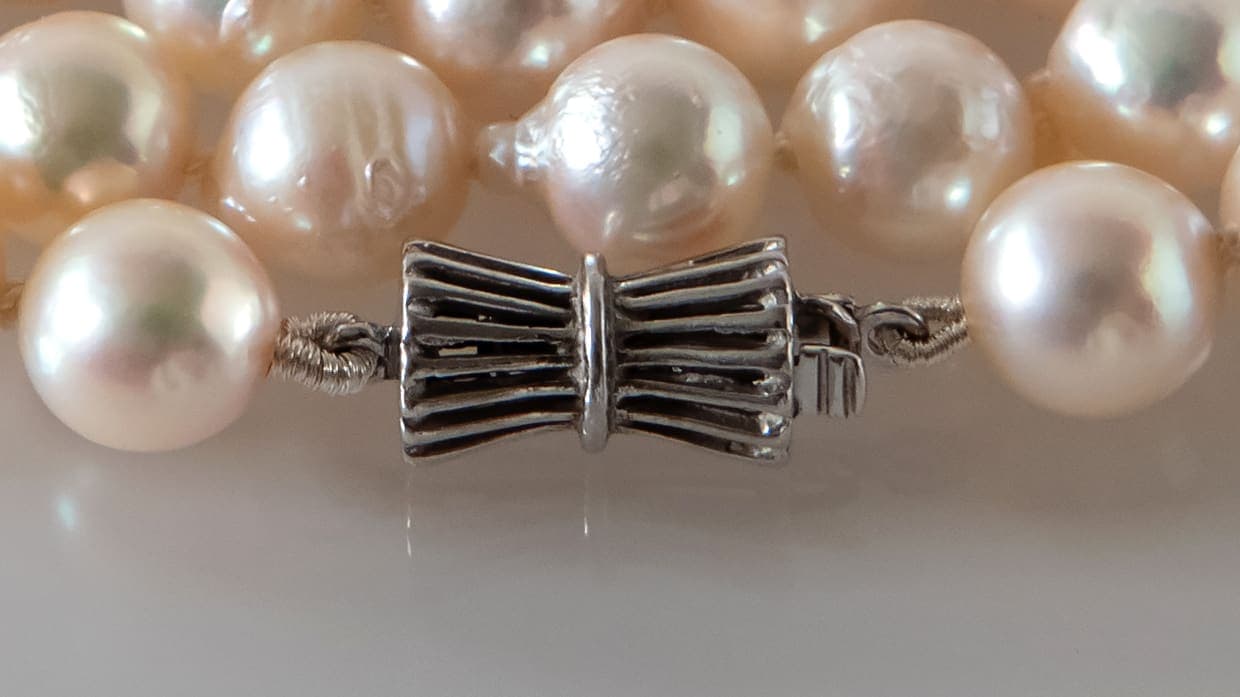
- Check the clasp for karat marks like 14K or 18K. A gold clasp suggests the pearls were considered valuable, though clasps can be swapped. A base-metal clasp often goes with costume strands.
Grail Hunt tip: Ask for a close-up photo of the clasp markings and a few drill holes. Those two shots answer more questions than a dozen glamour photos of the whole strand.
Get it tested
When value is on the line, trust a professional. A qualified gemologist can separate real from imitation quickly, and a gem laboratory can use techniques such as X-ray imaging to determine whether pearls are natural or cultured. For a strand described as natural, that testing is essential, since natural pearls are much rarer than cultured.
Buy safely online
Ask the seller how they know the pearls are real, whether they've been tested and whether the strand has been restrung. Request photos in natural light. Buy from sellers with strong jewelry feedback, check the return policy, and pay through the platform so buyer protection applies.
The bottom line
Use the tooth test, luster, surface, drill holes and clasp to build a picture — then let a gemologist confirm it. Real pearls reveal themselves in the details, and knowing where to look keeps you from paying pearl prices for glass.
More Vintage Jewelry guides