Stories · History · Pottery & Glass
Fiesta's Radioactive Red: The Dinner Plate Color the Atomic Age Took Away
Homer Laughlin's cheerful 1936 dinnerware owed its famous red-orange to uranium oxide, until the atomic age claimed the supply. The glowing story of Fiesta red.
By The Grail Hunt · August 29, 2026 · 4 min read
In 1936, in the middle of the Depression, the Homer Laughlin China Company of Newell, West Virginia, introduced a dinnerware line that looked nothing like the formal, flowery china many American households kept for best. It was called Fiesta, and it came in bold solid colors meant to be mixed and matched on the same table. One of those colors, a vivid red-orange, would become the most famous of them all, partly for its looks and partly for what was in it: uranium.
A bright answer to hard times
Fiesta was designed by Frederick Hurten Rhead, an English-born ceramic artist who served as Homer Laughlin's art director. The design was simple and strong, with concentric rings stepping around the rims of plates and bowls and streamlined shapes that suited the Art Deco taste of the decade. Rather than relying on printed decoration, Fiesta let color carry the whole effect.
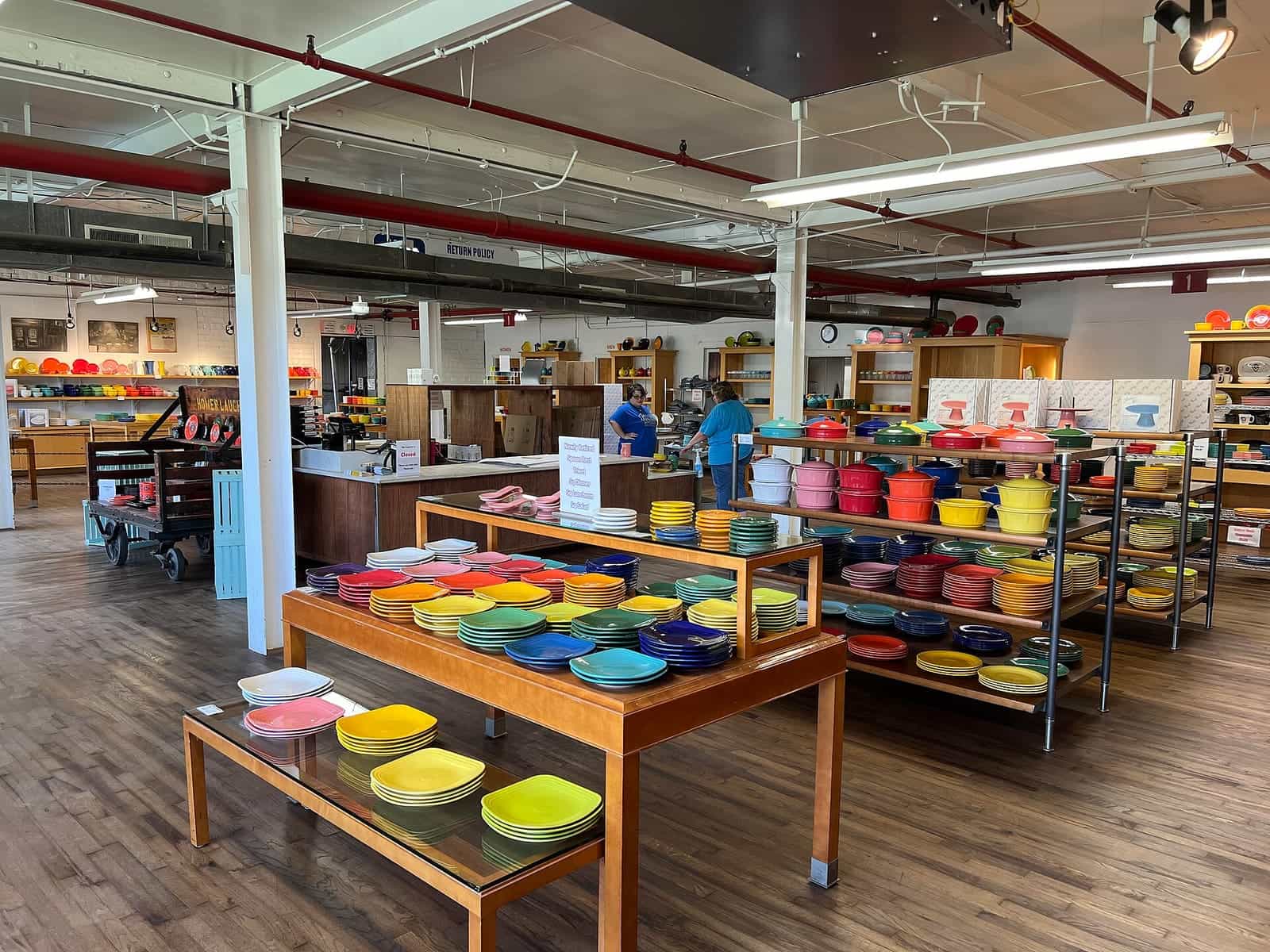
The original palette was red, cobalt blue, light green, yellow and ivory, with turquoise added soon after the launch. The idea of a table set in several colors at once was a large part of the appeal. It was cheerful, informal and affordable, and it was sold widely, through department stores and dime stores alike. Homer Laughlin was already one of the country's largest pottery makers, and Fiesta became one of its best-known products.
The secret in the glaze
The red that collectors now call Fiesta red owed its warm, orange-leaning color to uranium oxide in the glaze. This was not a secret or a scandal at the time. Uranium compounds had been used as colorants in ceramics and glass long before the 1930s, prized for the yellows, oranges and reds they could produce, and plenty of manufacturers used them. Before the atomic age, uranium was mostly thought of as an industrial pigment ingredient rather than a strategic material.
That changed quickly. Once the United States began work on atomic weapons during the Second World War, uranium became something the government wanted to control completely. Accounts differ on the exact mechanics, but around 1943 Homer Laughlin lost access to its uranium as federal authorities took control of the supply, and production of Fiesta red stopped.
The color that brightened Depression-era dinner tables was taken off the market because its key ingredient was needed for the atomic bomb program.
Red comes home
For more than fifteen years there was no new Fiesta red. The line continued in other colors, and the palette shifted over the years, with new shades introduced and old ones retired. Red did eventually return in 1959, once uranium was again available for such uses under government licensing. By then the glaze was made with depleted uranium, the material left over after the fissile portion had been removed for nuclear purposes.
Red remained in production until the early 1970s, and the original Fiesta line was discontinued around the same time. For a while, it seemed the story was over. Then in 1986, to mark the line's fiftieth anniversary, Homer Laughlin reintroduced Fiesta with new formulations and a new range of colors. The modern line was made without uranium, and later reds produced for the revived Fiesta are unrelated to the old glaze chemically, even where they resemble it on the table.
The Geiger counter at the flea market
Today, the radioactivity of vintage Fiesta red is one of the most talked-about facts in American collectibles. It shows up in science classes, museum displays and online videos, where a Geiger counter held near an old red plate begins clicking noticeably. Some collectors carry small radiation detectors to shows as a way of confirming that a piece is old, since the modern colors made without uranium will not register the same way. Reports suggest that some of the other early glazes can register too, though the red is the one best known for it.
It is worth being measured about what this means. Vintage Fiesta red does give off measurable radiation, and that is not in dispute. Radiation safety sources, including US government guidance on radioactive consumer products, generally describe simply owning or displaying such pieces as a low-level exposure. The more common caution concerns eating and drinking from them. Glazes from the era could contain lead as well as uranium, and there is concern that acidic foods, or glazes that are worn, chipped or crazed, may allow small amounts of those materials to leach into food. For that reason, many collectors choose to display vintage red pieces rather than use them for meals, and anyone with specific concerns is better served by official health guidance than by flea-market lore.
What it means for collectors
Vintage Fiesta survives in large numbers, because Homer Laughlin made so much of it and families kept it for decades. That abundance is what makes identification so important. Collectors look at the maker's marks on the underside, which vary across the years, and at the shapes and colors, since each color had its own production window. A given piece in a given color can only belong to certain years, and that is often the best clue to whether it is vintage or from the revived line.
Red has its own special position. Pieces from before the wartime pause and those from the 1959 revival are both sought after, and collectors pay attention to the depth and evenness of the glaze, crazing, chips and wear to the surface. The uranium content links Fiesta to a broader collecting world of uranium-bearing glass and ceramics, where glow under ultraviolet light and a reading on a detector are part of the fun. For Fiesta collectors, though, the red is not just a curiosity. It is a small piece of American history, a color that was pulled from dinner tables by the arrival of the atomic age.
More stories