Are $2 Bills Worth Anything? Red Seals, Star Notes and Common Myths
Most $2 bills are worth face value, but some aren't. Learn how series, red and green seals, star notes and condition separate ordinary deuces from collectible ones.
By The Grail Hunt · July 31, 2026 · 3 min read
This guide contains eBay affiliate links. If you buy through them we may earn a commission, at no extra cost to you. Read our affiliate disclosure.
Few pieces of American money carry as much mystery as the $2 bill. People tuck them into drawers, give them as good-luck gifts, and assume they must be rare. The truth is more interesting: most $2 bills are worth exactly two dollars, but certain series, seals, serial numbers and conditions can turn one into a genuine collectible. Here's how to tell which is which.
1. Start with the seal color
The color of the Treasury seal is your fastest first check:
- Green seal — These are Federal Reserve Notes, issued starting with Series 1976. They feature Thomas Jefferson on the face and a depiction of the signing of the Declaration of Independence on the back.
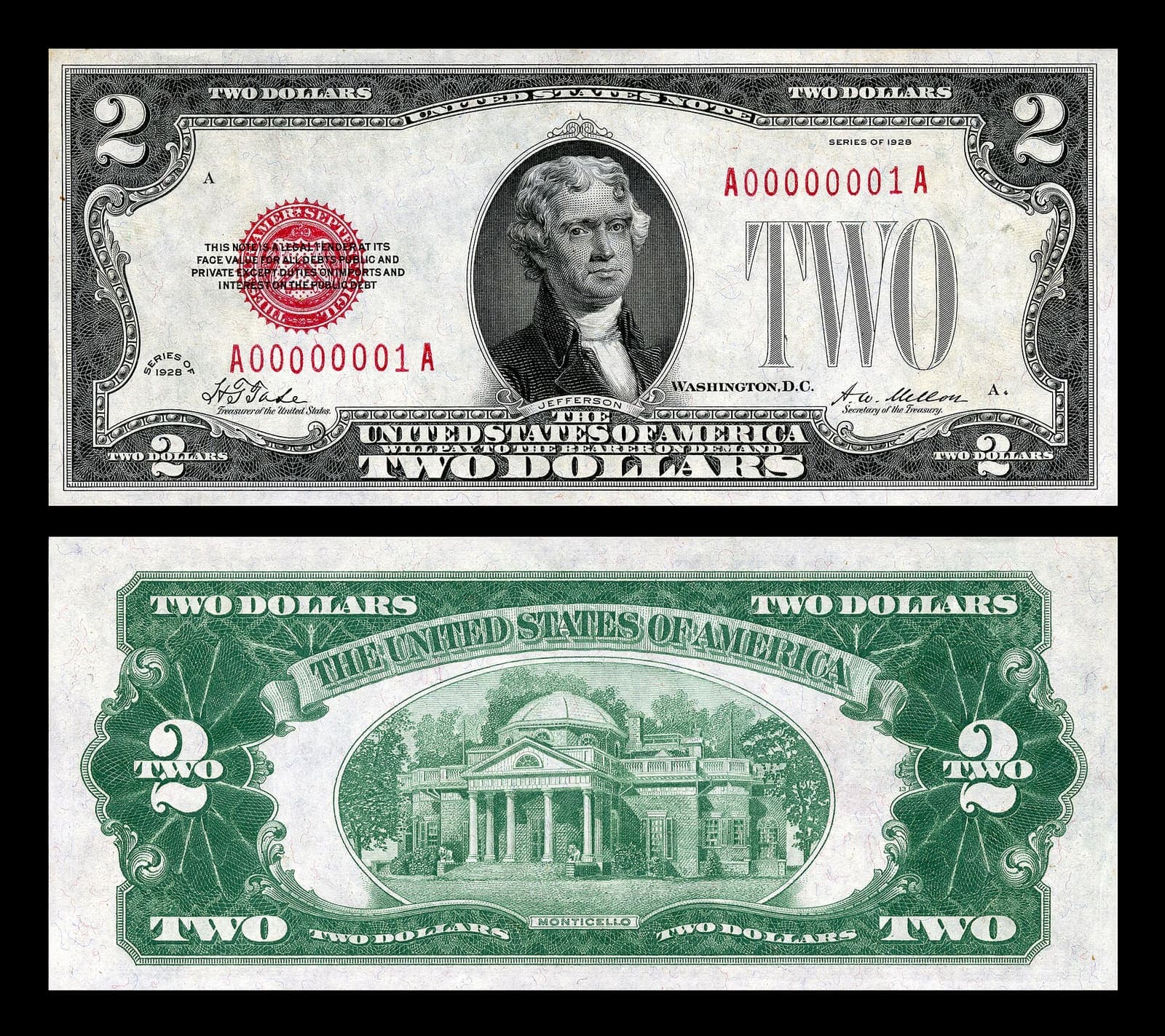
- Red seal — These are United States Notes, issued in small-size $2 series such as 1928, 1953 and 1963. They also feature Jefferson on the face, but with Monticello on the back.
Red seal notes are older and more interesting to collectors than modern green seals, though many red seal notes in circulated condition are still common. Condition and specific series drive most of their value.
2. Understand the series
The $2 denomination was not printed for a period in the late 1960s and early 1970s, and it returned with Series 1976, released on April 13, 1976 — Jefferson's birthday. Since then, the Bureau of Engraving and Printing has continued to produce $2 notes in newer series.
Before the small-size era, the U.S. issued large-size $2 notes, which are physically bigger than today's bills. These include famous designs such as the 1896 "Educational" silver certificate and the 1918 "Battleship" Federal Reserve Bank Note. Large-size notes are a different world from modern $2 bills and are widely collected.
3. Star notes
A star note has a small star next to the serial number. Stars mark replacement notes, printed to replace sheets damaged during production. Because they're made in smaller numbers, star notes tend to attract collector interest — but the premium depends heavily on the series, the specific print run and condition. Some modern star runs are quite common; others are genuinely scarce.
4. Fancy serial numbers
Collectors also look for fancy serial numbers, including:
- Low serial numbers, such as 00000001 through 00000100
- Solids, where every digit is the same
- Ladders, such as 12345678
- Radars, which read the same forward and backward
- Repeaters, where a group of digits repeats
A note with a truly unusual serial number can be worth more than face value even if it's otherwise ordinary.
Grail Hunt tip: Before you spend or sell a $2 bill, check three things: the seal color, whether there's a star in the serial number, and whether the serial number follows an unusual pattern.
5. Condition and buying safely
For most $2 notes, condition is the biggest value driver. A crisp, uncirculated note with sharp corners, bright paper and no folds is far more desirable than a worn one. Common condition problems include:
- Folds and creases, even a single center fold
- Stains, tears, pinholes or writing
- Washing or pressing, which can make a worn note look crisper than it really is
Paper money is graded on a 1–70 scale, with PMG and PCGS Banknote the most widely recognized services. For anything valuable, a certified grade removes the guesswork. When buying online, ask for full photos of both sides including all corners, ask whether the note has been folded, washed or pressed, verify certification numbers, and pay through a marketplace with buyer protection.
6. Common myths
- "$2 bills are rare." They're less common in daily use, but many have been printed.
- "They're no longer made." The $2 bill is still legal tender and still printed.
- "Every 1976 bill is valuable." Most Series 1976 notes are common. Condition, star notes and special serials are what matter.
- "Stamped 1976 bills are worth a fortune." Some people had 1976 notes postmarked with first-day stamps. These are fun collectibles, but their appeal varies, and many exist.
The bottom line
Most $2 bills are fun to own and worth face value. The ones that stand out are older red seal notes, large-size issues, star notes, fancy serial numbers and anything in truly uncirculated condition. Learn those clues, ignore the myths, and you'll know exactly when a deuce deserves a second look.
The story behind it
More Paper Money guides