Genuine Confederate Currency vs Reproductions: How to Tell Them Apart
Most Confederate notes found in attics and online are souvenir copies. Learn the paper, printing and facsimile clues that separate real notes from reproductions.
By The Grail Hunt · August 1, 2026 · 3 min read
This guide contains eBay affiliate links. If you buy through them we may earn a commission, at no extra cost to you. Read our affiliate disclosure.
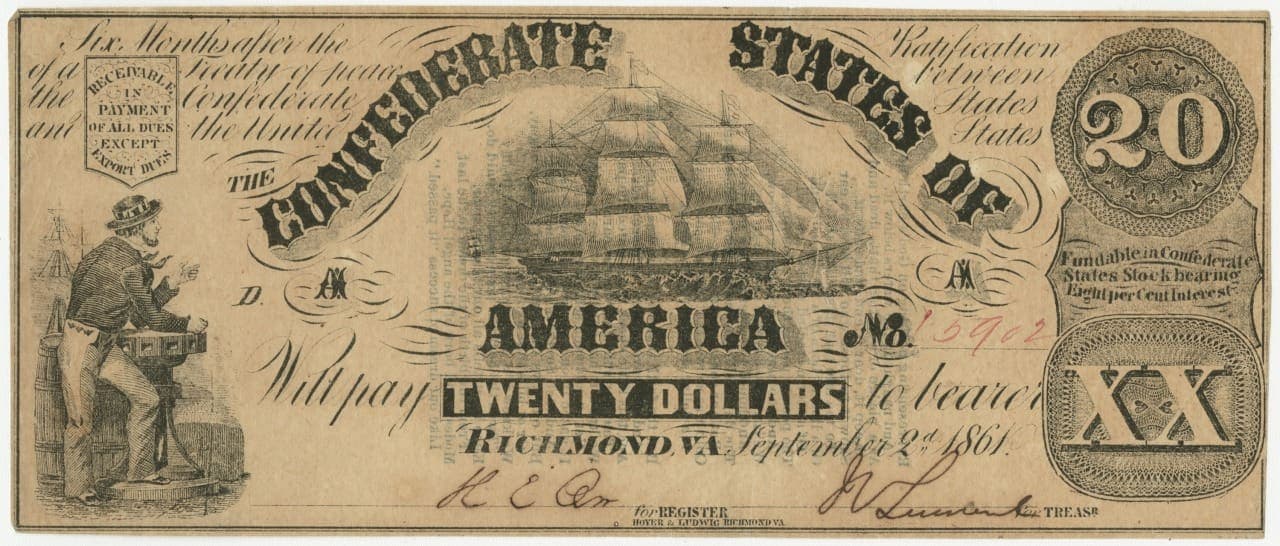
Confederate paper money is one of the most fascinating areas of American numismatics — and one of the most confusing. The Confederate States issued paper money throughout the Civil War, from 1861 to 1864, and genuine notes survive in large numbers. But reproductions survive in even larger numbers. Souvenir copies have been printed and sold for well over a century, and many of them are now old enough to fool an inexperienced buyer.
1. Understand what's out there
Confederate notes you'll encounter generally fall into a few groups:
- Genuine notes issued by the Confederate government, in denominations ranging from fractional amounts up to high values
- Contemporary counterfeits made during the war to pass as money — many of which are collectible in their own right
- Nineteenth-century facsimiles, most famously those sold by Samuel Upham of Philadelphia
- Modern reproductions made as souvenirs, for teaching, for film props and for gift shops
The 1864 issue is by far the most commonly encountered genuine series. The earliest issues, especially the first notes printed in 1861, are major rarities — and among the most reproduced.
2. The facsimile trail
Samuel Upham printed large numbers of "fac-simile" Confederate notes during the war and sold them as novelties. His notes carried a printed imprint in the bottom margin identifying them as facsimiles. Many were trimmed to remove that line and then passed as real money, and today they're collected as a distinct category. If you see a note with a suspiciously narrow bottom margin, take a closer look.
Modern reproductions are often less subtle. Many carry the words "FACSIMILE" or "REPRODUCTION", sometimes in small type on the back or in a margin. Always check both sides of the note carefully.
Grail Hunt tip: If you find several Confederate notes together that share the same serial number, the same "signatures" and the same tan color, you almost certainly have a souvenir set, not a stash of genuine money.
3. Paper clues
Paper is one of the quickest giveaways:
- Modern reproductions are frequently printed on thick, stiff, parchment-like or artificially aged paper with a uniform brown or yellowed tint
- Genuine notes were printed on a variety of papers, many of them relatively thin, and some on watermarked paper
- Coffee-stained or "antiqued" color that looks even across the whole note is a common reproduction trick
- Crisp, glossy or plasticky paper that doesn't feel like old rag-based paper should raise questions
4. Printing and signature clues
Genuine Confederate notes were produced by a handful of printers using engraving and lithography, and quality varied — so crude printing alone doesn't mean a note is fake. Instead, look for these specific clues:
- Hand signatures and hand-written or stamped serial numbers. Many genuine notes were signed by hand, usually by clerks on behalf of Confederate officials, and numbered individually. Reproductions often have printed signatures and serial numbers that look identical from note to note.
- Dot patterns. Under magnification, modern reproductions often show the tiny dot pattern of modern printing.
- Backs. Many genuine notes have plain backs, while others have printed designs. A back that doesn't match known genuine examples for that type is a warning sign.
- Size. Compare dimensions to a reference; reproductions are sometimes slightly off.
5. Identifying notes by type
Serious collectors identify Confederate notes by type numbers used in specialist catalogs, based on the design, denomination and issue. Knowing the type tells you what a genuine example should look like and how scarce it is. Many types also have varieties based on printer, paper or plate details. A good specialist reference is one of the best purchases you can make before buying.
6. Buying safely online
- Ask for full, high-resolution photos of both sides, including all margins
- Ask whether the note has been authenticated, repaired or trimmed
- Be wary of listings that describe notes as "old," "antique" or "Civil War era" without stating they're genuine
- For higher-value notes, buy certified by PMG or PCGS Banknote and verify the certification number
- Use a marketplace with buyer protection and check the seller's feedback on paper money
The bottom line
Assume a Confederate note is a reproduction until the evidence says otherwise. Check the margins for facsimile text, study the paper, look for hand signatures and individual serial numbers, and identify the note by type. For anything rare or pricey, buy it certified — and enjoy owning a genuine piece of Civil War history.
More Paper Money guides